Oct 2026 – Nov 20262nd place · Excellence AwardCompetition
Team Member · Perception, Data & Field Integration · Team WIC, Hanyang University
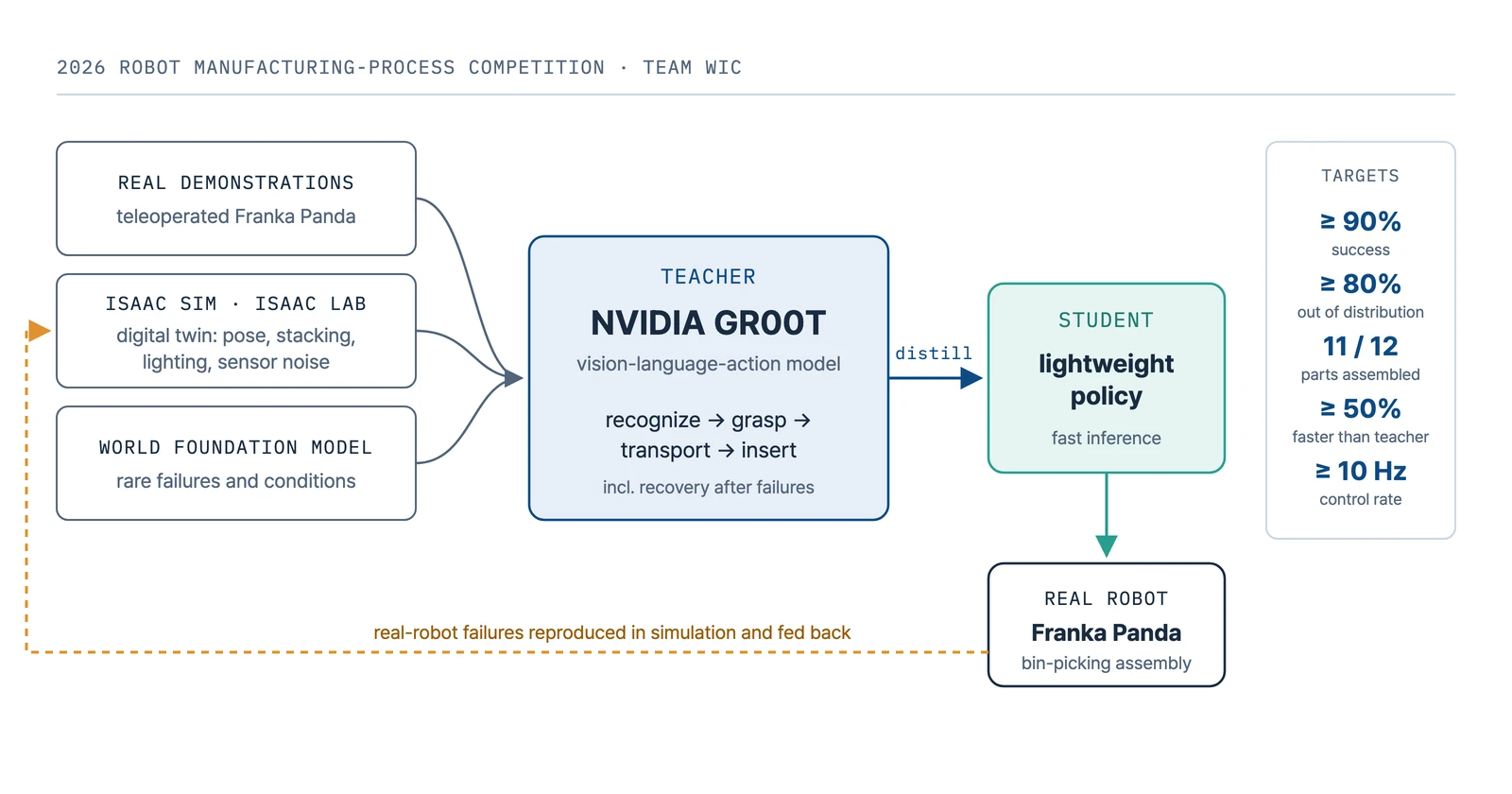
Placed 2nd and received the Excellence Award at KETI’s 2026 robot manufacturing-process competition with a three-person lab team, where I was the only undergraduate alongside two master’s students. A Rainbow Robotics RB10 picks three kinds of parts out of a bin and inserts them into matching guides. After a GR00T VLA design proved too slow, we built a modular pipeline: YOLO26 instance segmentation fine-tuned on real RealSense D415 images, calibrated geometric pose estimation, and SDK-driven motion.
Details
- Proposed the initial GR00T vision-language-action (VLA) teacher–student design; the team moved to a faster modular pipeline when speed became the constraint.
- Trained the YOLO26 segmentation model and collected real D415 data; on held-out real viewpoints it found all 144 targets with no false positives, where the synthetic-only model had missed every guide.
- Before the competition, added the containerized SDK runtime, TCP position control, lens and yaw calibration, force-controlled gripping, shorter motion routes, and operator-console updates.
- Responsible for model training, code verification, and data collection.
Technologies: YOLO26 (instance segmentation) · Intel RealSense D415 · Rainbow Robotics RB10 · Zimmer GEH6060IL Gripper · MuJoCo · Python · Docker · NVIDIA GR00T (initial design)
Summer 2026CourseworkAI-based 3D Autonomous Driving: 3D From NeRF to World ModelsSummer 2026
3D Gaussian Splatting Reconstruction
Team Project
Built an end-to-end COLMAP-to-3D Gaussian Splatting pipeline from captured indoor video, studying the practical relationship between camera-pose estimation, sparse geometry, initialization, and reconstruction quality.
Details
- Extracted frames from 720p video, estimated camera poses and sparse geometry with COLMAP, undistorted images, and trained 3DGS reconstructions.
- Compared reconstructions for a doll-on-table, table-only, and room scene; the best doll-on-table result reached PSNR 32.14.
- Showed that camera poses were essential to reconstruction quality, while sparse points served as initialization rather than ground-truth labels; random-point initialization reduced PSNR from 32.14 to 24.54.
- Identified COLMAP as the primary pipeline bottleneck: the 6 fps doll scene took about 51 minutes for COLMAP versus about 16 minutes for 30k 3DGS iterations.
Technologies: COLMAP · 3D Gaussian Splatting · CUDA · Conda · FFmpeg
Summer 2026CourseworkData Labeling and Model Building for Physical AISummer 2026
Data Labeling and Model Building for Physical AI
Coursework Project
Followed the full data-to-driving workflow by collecting camera data, curating and annotating a dataset, training a model, and designing an autonomous-driving algorithm.
Details
- Collected and organized camera data directly, then annotated the dataset for model training.
- Trained a perception model from the labeled data and used the resulting pipeline to design an autonomous-driving algorithm.
- Learned how label balance, data coverage, and overall data quality can determine model behavior throughout the training process.
- Approached annotation as a model-aware task, including bounding boxes for small objects when they matter to the intended driving behavior.
Technologies: Computer Vision · Data Annotation · Object Detection · Python · OpenCV
Mar 2026 – Jun 2026CourseworkECL4015Applied Power ConversionSpring 2026 · Senior year, Semester 1
LLC Resonant DC-DC Converter for an EV On-Board Charger
Design & Validation
Designed and verified an LLC resonant DC-DC converter for an electric-vehicle on-board charger, from resonant-network design and component selection through switching-level simulation.
Details
- Designed for an 800 Vdc input, 400/500/600 V outputs, and 25–100% load conditions while maintaining zero-voltage switching across the specified range.
- Derived resonant-network parameters and voltage-gain curves, then estimated MOSFET and diode losses and converter efficiency for each load condition.
- Built a PSIM switching model and verified operating waveforms, ZVS, output ripple, load-dependent efficiency, and weighted efficiency.
- Compared a MATLAB parameter sweep with PSIM results, traced the discrepancy to harmonic content omitted by the analytical approximation, and selected the final parameters from waveform-based simulation.
- Verified dead time and adjusted resonant frequency and capacitor values under switching-frequency and commercially available component constraints.
Technologies: PSIM · MATLAB
Mar 2026 – Jun 2026CourseworkECL4007Renewable Distributed GenerationSpring 2026 · Senior year, Semester 1
PV & Wind Power System Modeling
Team Leader
Modeled the power-conversion and control structures of photovoltaic charging and wind generation systems in MATLAB/Simulink.
Details
- Implemented a PV array, boost converter, and P&O and Incremental Conductance MPPT control.
- Modeled a wind turbine, PMSM, rectifier, buck converter, and optimal-current control.
- Analyzed low-wind limitations and tested a buck-boost topology to improve tracking.
Technologies: MATLAB · Simulink
Jan 2026 – PresentIn progressPersonal
HOYA LAB: Robot Learning Research Blog
Writer & Operator
Operate a technical blog that connects robot-learning theory with practical research notes and implementation-oriented study.
Details
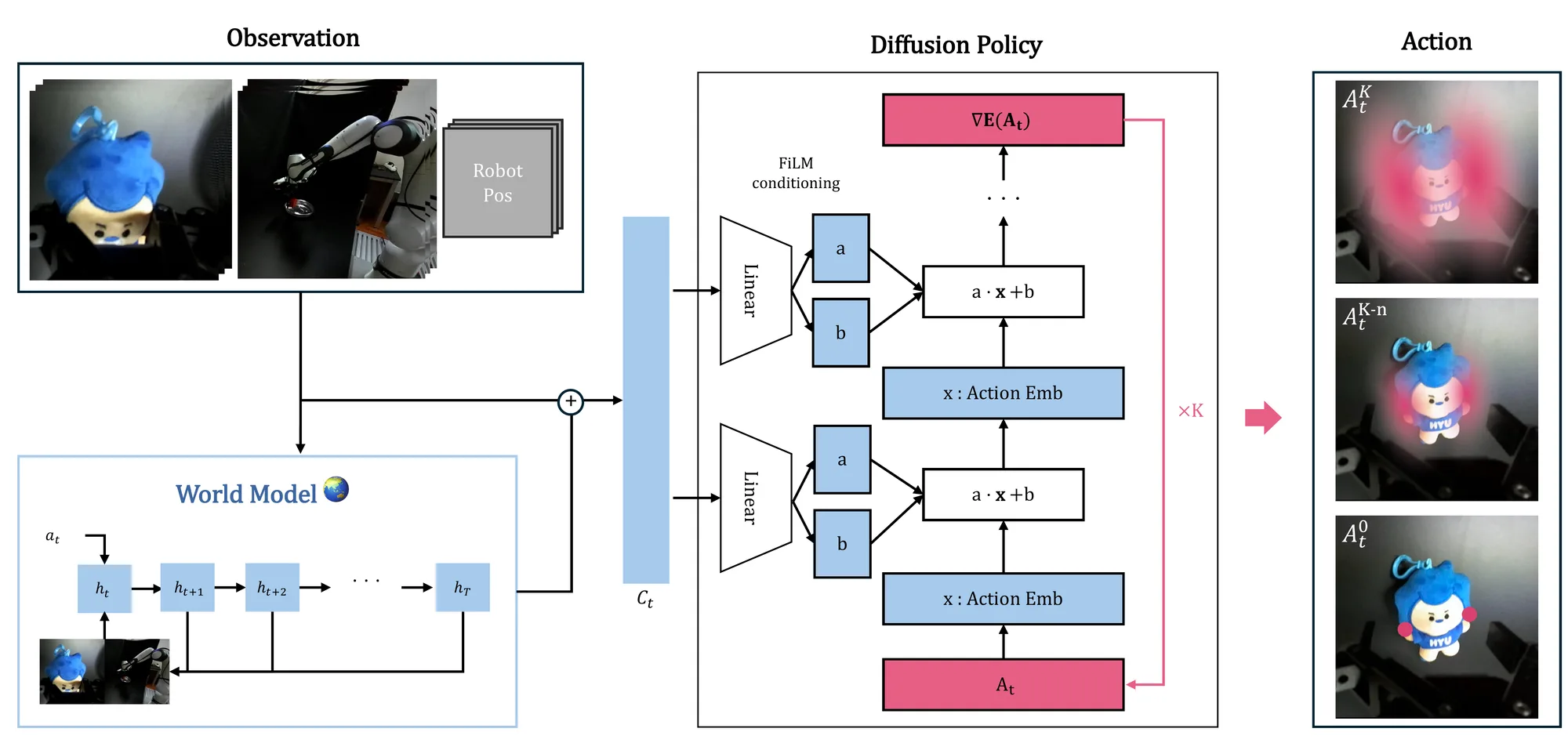
- Write structured learning notes on diffusion models and Diffusion Policy, from core concepts to their use in robot learning.
- Cover World Model research topics alongside reinforcement learning, imitation learning, and robotics papers.
- Document practical study and research context so theoretical material remains connected to experiments and implementation.
Technologies: Tistory · Robot Learning · Diffusion Policy · World Model
2026 – PresentIn progressCoursework
MediGrip: Autonomous Surgical Instrument Delivery Cart
Team Leader
Developing a non-clinical proof-of-concept cart that combines voice commands, visual recognition, and robot manipulation to move dummy surgical instruments from a tray to a designated delivery zone.
Details
- Designed a three-layer pipeline for wake-word-triggered command recognition, tray-level instrument and inventory recognition, and imitation-learning-based pick-and-place.
- Defined a closed-vocabulary voice workflow that activates STT only after the “Hey Mary” wake word and extracts an instrument name from the subsequent utterance.
- Selected placement in a designated delivery zone instead of direct robot-to-human handover to reduce contact paths and keep the manipulation task feasible.
- Planning the SO-ARM101 cart layout around its effective reach, with an overhead tray camera and a wrist camera for instrument recognition and manipulation.
- The manipulation-policy architecture remains under evaluation; this project does not claim readiness for real operating rooms, patients, or clinical instruments.
Technologies: SO-ARM101 · LeRobot · Whisper · VAD · Computer Vision · Imitation Learning
Summer 2025CourseworkGEN5026Techno-BusinessSummer 2025
Prototype Styler: ESP32-Controlled Garment-care Device
Team Leader
Led a five-person team to complete an ESP32-controlled prototype styler in three days, combining mobile control, relay-switched functions, and a 12 V power system.
Details
- Designed the electrical power path around a 12 V, 30 A SMPS and DC-DC buck converters to supply the prototype subsystems.
- Built an ESP32-based mobile control page and used relay modules to switch the device functions from the web interface.
- Integrated prototype functions including PTC heating, ultrasonic humidification, UV lighting, and vibration, with fusing and supporting passive components in the electrical design.
- Coordinated rapid mechanical enclosure fabrication using acrylic panels, hinges, handles, and assembly materials during the three-day build.
Technologies: ESP32 · HTML/CSS/JavaScript · Relay Module · SMPS · DC-DC Converter
May 2025 – Jun 2025CourseworkMAT3008Numerical AnalysisSpring 2025 · Junior year, Semester 1
GPS/IMU-based Velocity & Trajectory Estimation
Team Leader
Compared numerical differentiation, integration, and Kalman-filter sensor fusion methods to estimate vehicle velocity and reconstruct its trajectory from real GPS and IMU measurements.
Details
- Preprocessed acceleration, yaw-rate, GPS Speed2D, wheel-speed, and position data at 100 Hz; applied a high-pass Butterworth filter and converted between geographic and local ENU coordinates.
- Implemented and compared ten velocity-estimation approaches: four GPS differentiation methods, five IMU integration methods, and KF-RK4 sensor fusion.
- Found the 3-point central difference to be the most reliable GPS differentiation method, while the 5-point method was degraded by edge effects and noise sensitivity.
- Reduced IMU integration drift by fusing RK4 predictions with reference measurements through a Kalman Filter, achieving a velocity RMSE as low as 0.04 and the lowest path RMSE among the tested methods.
- Reconstructed the vehicle path using estimated velocity and integrated yaw rate, and analyzed late-trajectory divergence caused by accumulated heading drift; selected as an outstanding project team.
Technologies: MATLAB